There’s a reason the fitness industry keeps selling new, complicated-sounding solutions to fat loss, and it’s not that the answer is complicated. It’s that the answer is boring, and boring doesn’t sell transformations.
The answer is this: fat loss is governed by the laws of thermodynamics, and you cannot beat them. Energy in minus energy out. That’s the whole mechanism. Every diet that “works” works because it gets you into a calorie deficit; every diet that fails fails because it doesn’t — or because it can’t keep you there. There is no supplement, no fasting window, no “fat-burning” food that overrides the arithmetic.
Which means the entire game reduces to a single, unglamorous question: do you actually know how much you’re eating?
The science is settled. The variable is you.
Nothing about energy balance is in dispute. It’s not a theory with competing camps — it’s a law, the same one that governs whether an engine runs hot or an ice cube melts. If you consume less energy than you expend, you lose tissue. If you consume more, you gain it. The macronutrients just tune what kind of tissue and how the deficit feels — hunger, energy, muscle retention — but the direction of the scale is set by the total.
So if the physics is fixed, the only thing left to control is the input side. And here’s the uncomfortable part: you can’t control what you don’t measure.
This is where almost everyone quietly fails. Most people trying to lose fat are not actually eating the number they think they’re eating. The research on dietary self-report is brutal and consistent: people under-report their calorie intake by roughly 30–50% on average. Not a little. Not the occasional forgotten snack. A systematic, structural blindness — a third to a half of what’s going in isn’t making it onto the mental ledger.
We’re not lying on purpose. We’re estimating, and human estimation of portions is terrible. We forget the splash of oil. We round down the “handful.” We don’t count what we grazed while standing at the counter. We log the salad and skip the dressing. Each error is small. Together, they erase the entire deficit we thought we’d created — and then we blame our “slow metabolism.”
The metabolism isn’t the problem. The measurement is.
The “just eyeball it” myth
There’s a seductive piece of advice floating around that says you don’t need to track anything — just “eat intuitively,” “listen to your body,” “stop overthinking it.” It’s the modern rebrand of “trust your instincts.”
Here’s what intuitive eating reliably produces in someone whose goal is fat loss: maintenance, at whatever weight their instincts are used to. Because your instincts didn’t evolve for a world of hyper-palatable, calorie-dense food that’s always available. Your body’s hunger signals are tuned to a version of reality where food was scarce and worth gorging on. Trust those signals in a modern food environment, and you’ll “intuitively” eat exactly enough to stay where you are — or slowly gain.
Intuitive eating is a fine state to arrive at once you’ve learned, through measurement, what a real portion actually looks like. It’s a terrible place to start from when you don’t yet know that. You can’t listen to a signal you’ve never calibrated.
The villain in this story isn’t your discipline and it isn’t your body. It’s the comfortable illusion that you already know what you’re eating. You don’t. Almost nobody does — until they measure it.
Why tracking is the fix (and why it’s a pain at first)
Measurement is what turns a vague intention into a controlled variable. It’s the difference between “eat less” — which is a wish, not a plan — and “eat 1,900 calories a day,” which is a number you can hit, miss, and correct.
But let’s be honest about the part nobody sells you: it’s annoying at first. Weighing food, looking up entries, logging before you eat. It feels like homework. It interrupts the flow of the meal. For the first week or two, it’s friction, and friction is exactly where new habits go to die.
That’s not a reason to skip it. It’s a reason to expect the friction and push through it the same way you once pushed through the early weeks of the gym.
Because here’s the thing nobody tells you, and it’s the whole point: tracking gets easier — dramatically — and the ease compounds.
It becomes a habit, exactly like the gym
Think back to the first time you started training. Every session felt like a decision. Am I going today? What am I doing? Does this even work? It took real effort to show up, and the effort was mostly mental, not physical. Now — for anyone who’s been consistent for a year — going to the gym just is. It costs about as much mental energy as brushing your teeth. The decision made itself somewhere along the way, and it’s been running on autopilot ever since.
Food tracking behaves identically. The first two weeks are the hard part, and the difficulty is almost entirely cognitive friction, not real burden. Then three things happen:
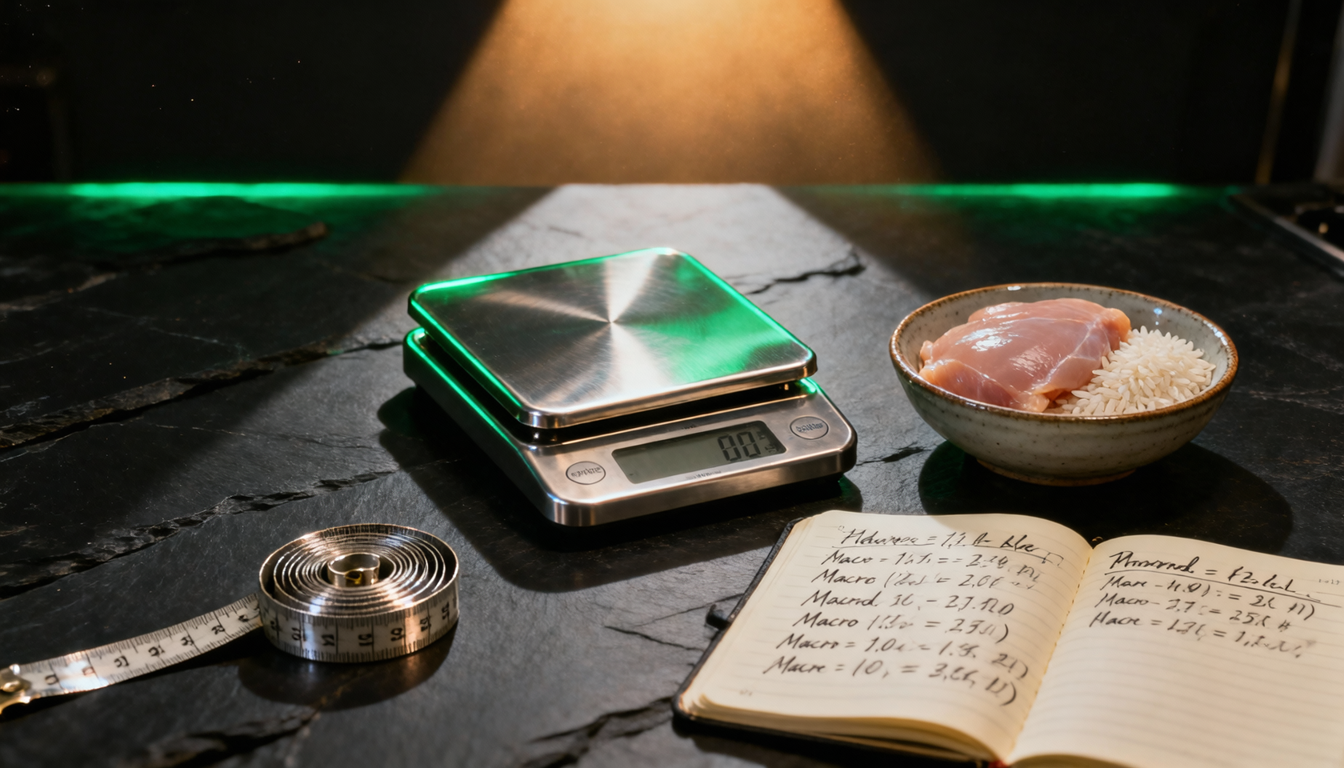
You eat the same thing you always eat. Most people have a rotation of maybe 10–15 meals. Once you’ve logged “the usual chicken and rice” a few times, it’s one tap, not a calculation. You’re not logging from scratch every meal — you’re recalling.
You learn portions by feel. This is the quiet superpower. After a month of weighing, you can look at a chicken breast and know it’s 150 g, not 90. The scale becomes a training wheel. You calibrate your eye against reality until your eye is good enough on its own — at which point you can relax and still be accurate, because the skill is now in you.
The results become the reward. Once you can see the relationship between what went in and what the scale did, the whole thing stops being deprivation and starts being causality you control. You’re not guessing anymore. You’re running an experiment where you’re the subject and the scientist, and for the first time the numbers actually move the way the physics says they should.
Far from becoming a lifetime of tedious logging, tracking front-loads into a period of deliberate measurement, then relaxes into a permanently sharper sense of how much food is in the food in front of you. The pain is real. It’s also short, and it pays back for a decade.
Track the trend, not the day
One caution, so the tool doesn’t become a new trap. A single day’s number is noise — water weight, salt, timing, sleep all move the scale more than one day’s fat does. If you’re going to measure, measure the trend: the weekly average, the trajectory over two or three weeks.
This is the same discipline that applies to every decade-scale habit on this site. Crash diets fail because they yank the body into famine and then stop with no plan for the rebound. The steady, measured approach — a consistent, modest deficit, tracked honestly — is the one that survives contact with a normal life.
And measurement is how you run a cut or gain phase in the first place. Whether you’re stripping fat or building muscle, the phases only work if the intake is controlled. You can’t structure what you can’t see.
The boring truth
Nobody wants to hear that the answer is “measure your food,” because it sounds like work and it doesn’t promise a transformation in six weeks. But it’s the only answer that’s ever actually worked, and it works for a simple reason:
You cannot beat the science. But you can stop fighting it and start working with it — and the first move is to see the numbers clearly.
Know the macro. Measure what you eat. Accept that the first two weeks will be a pain. Then let the habit take over, the same way the gym did — and watch the decade finally start paying out.
And if you don’t have a tracking method yet, don’t start with pen and paper. Use an app — one that does the weighing and the math for you. GainCut turns every meal into a macro breakdown from a single photo, so the only thing standing between you and the numbers is pointing your phone at your plate.
Sources
- Energy balance / thermodynamics of weight loss — Weight and body-composition change are governed by the first law of thermodynamics (energy in vs. energy out); every effective dietary strategy for fat loss operates by creating a sustained calorie deficit. No intervention overrides energy balance, including food composition or meal timing (Hall et al., reviews of energy metabolism).
- Under-reporting of dietary intake — Multiple doubly-labeled water and biomarker studies consistently find that self-reported energy intake underestimates true intake by roughly 30–50% on average; obese individuals under-report by even larger margins (Schoeller; Lichtman et al., New England Journal of Medicine, 1992; Archer et al., 2013).
- Estimation vs. measurement of portions — Portion-size estimation errors are a primary driver of inaccurate dietary self-report; weighed/measured intake, even brief periods of it, calibrates portion perception and meaningfully improves accuracy.
- Habit formation and automaticity — Repeated behavior in a stable context becomes increasingly automatic, reducing the cognitive effort of performance over time (Lally et al., 2010, European Journal of Social Psychology — habit formation, though often slower than the popular “21 days” claim).
- Calorie tracking and weight loss — Self-monitoring of food intake is one of the most consistent predictors of successful weight loss and maintenance across behavioral weight-loss studies (Burke et al., 2011 meta-review).