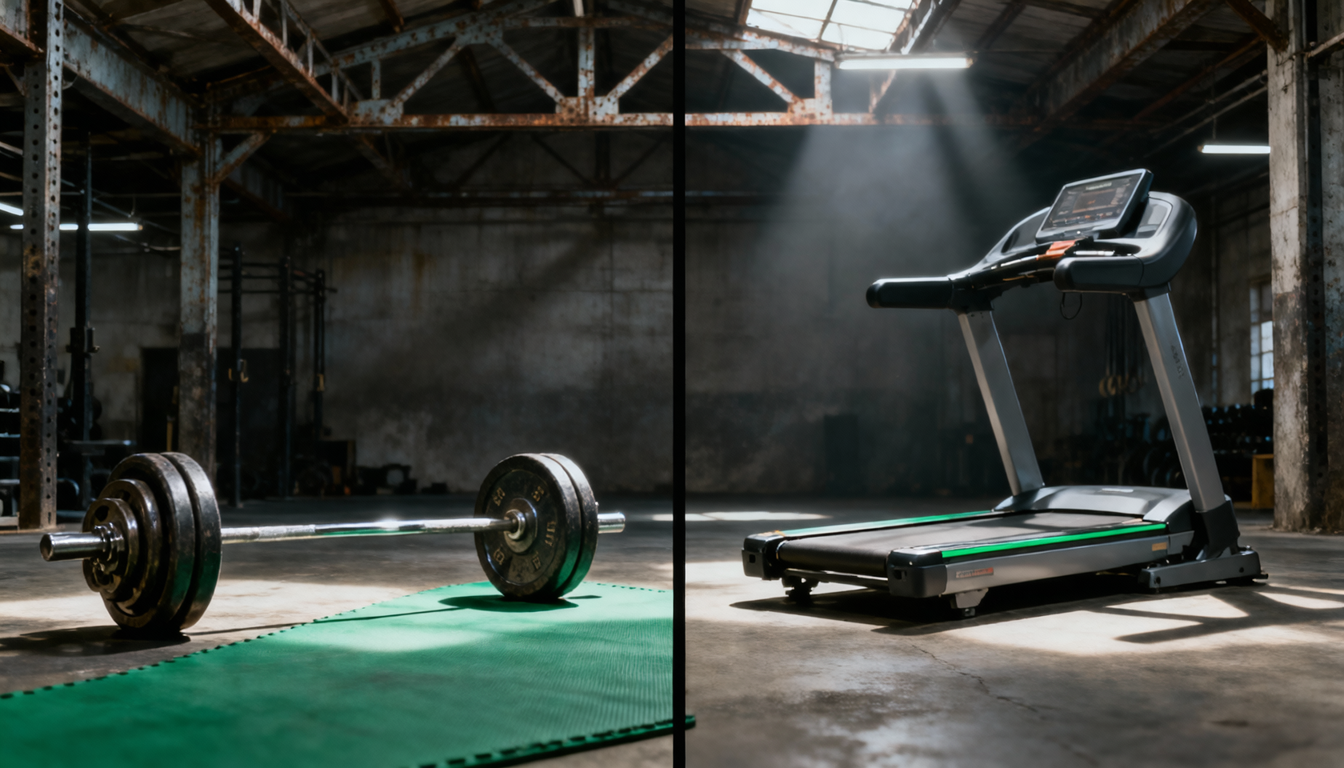
Cardio or strength first? The answer (and why)
The question sounds like a chore nobody should have to solve: do I lift weights or do cardio first? But behind it sits a tension every man over 40 eventually feels — there’s only so much time and recovery in a week, and you keep hearing that both are essential.
Good news: for almost everyone, the evidence points the same way. Put strength training first — both in priority and in workout order — and treat cardio as the supporting player, not the main event.
That’s not a dismissal of cardio. It’s a statement about what each tool is actually for — and getting them the wrong way round is one of the quietest ways men waste a decade on the wrong lever.
Why strength comes first (the body-composition argument)
Here’s the mechanism the “just do more cardio” advice ignores: muscle is the engine that makes everything else work.
Muscle is metabolically active tissue — it burns energy all day, not just during exercise. When a man over 40 loses muscle (which he does, ~3–8% per decade without intervention), his resting metabolism slips with it. That’s why so many men “eat less and move more” yet still put on fat: they’ve been cutting calories on a shrinking engine instead of rebuilding the engine.
Strength training reverses that. Adding muscle raises metabolism, improves insulin sensitivity, and reshapes body composition in a way steady-state cardio simply can’t. Cardio is excellent at burning calories during the session; strength training changes how your body burns them the other 23 hours — and for the long game, that’s the lever. This is the same reason muscle is metabolic armor, not vanity — and if you’re starting from zero, how much protein you actually need matters as much as the training itself.
The session-order question (same answer, smaller scale)
When they are in the same workout, lift first. The logic is the same: strength work is the higher-value, more technique-dependent activity, and you want to do it fresh, not pre-fatigued.
A loaded squat after 40 minutes of running is a different animal than a loaded squat done fresh — your stabilizers are tired, your form degrades, and your injury risk climbs. Cardio, by contrast, degrades gracefully with fatigue; it’s the more forgiving activity to do second.
The exception proves the rule: if you’re training specifically for an endurance event, cardio gets priority on some days — that’s the zone 2 and VO2max work worth building deliberately. But for the goal that matters to most over-40 men — body composition, strength, and healthspan — lift first, then move. If you’re not training at all yet, start with how to start training over 40.
What “cardio as support” actually looks like
This isn’t a license to sit on the couch. Cardio is non-negotiable for heart health, recovery, and insulin sensitivity — it’s just not the primary body-composition tool. The evidence-backed dose for the goal most men have:
- Daily walking — the unsung hero. Thirty minutes of brisk walking daily improves insulin sensitivity, aids recovery between lifting sessions, and quietly burns a few hundred calories without the stress of “cardio”. This is cardio most people forget to count.
- 2–3 short, harder sessions a week — if you want more, add a couple of 20–30 minute moderate sessions or a single interval session. But it’s the garnish, not the meal.
The over-40 trap isn’t doing too much cardio — it’s doing cardio as the foundation while neglecting the strength work that actually changes body composition. The practical version of “cardio as support” is exercise snacking — short daily bursts that fit a real schedule.
The decade framing
Think of it as an engine question, because that’s literally what it is. Cardio improves the machine’s efficiency. Strength training rebuilds the engine itself.
A man at 45 who spends a decade running but never lifting ends up lighter but softer, with less muscle protecting his joints, bones, and metabolism. A man at 45 who lifts two or three times a week and walks daily ends up with the engine rebuilt — and then any cardio he adds on top actually works, because he’s not running a shrinking machine.
Neither is wrong. The order is what’s wrong when it’s reversed. Build the engine first; then make it efficient.
Sources
- Muscle loss with age — Muscle mass declines roughly 3–8% per decade after 30, accelerating with age; resistance training reverses this in even the oldest cohorts (see Frontera et al. 1988, strength gains in untrained 60–72-year-olds).
- Resistance vs. aerobic for body composition — Meta-analytic evidence shows resistance training improves lean mass and resting metabolic rate, while aerobic training contributes primarily to fat loss during the exercise bout; combining both maximizes overall health, but resistance is the primary driver of body-composition change.
- Concurrent training order — Studies on concurrent strength + endurance training find that strength performance is more impaired when cardio precedes lifting than the reverse, supporting the “lift first” ordering for quality and injury risk.