Here’s a quiet confession most lifters over 40 would never say out loud: they’ve spent thousands of hours making their body do things, and almost no hours learning to feel what it’s telling them.
Strength is output. You know output — sets, reps, load, progressive overload. But there’s a second signal you’ve been ignoring, and it’s the one your body uses to keep you out of pain, to tell you when to push and when to back off, to keep one bad rep from becoming a six-month injury.
That second signal has a name: interoception — your ability to sense your body from the inside. And it is trainable, exactly like your squat.
The missing layer: interoception, not vibes
Most men hear “body awareness” and picture a yoga class or a meditation app — soft, vague, something other people do. That’s the villain of this story: the idea that feeling is the opposite of training, when in fact it’s the input channel that makes training safer and more effective.
Interoception is the specific, measurable skill of reading internal signals — joint position (proprioception), muscle tension, breath, fatigue, discomfort. A lifter with poor interoception can’t tell the difference between “sore and safe” and “about to strain.” So they either grind through the warning sign, or they get spooked by normal soreness and stop entirely. Both are the same failure: a loud output loop and a deaf input loop.
The nervous-system post we wrote on why your muscles are fine but your nervous system is fried covers the output side — central fatigue, why the bar feels bolted to the floor. This is the input side: the awareness that tells you it’s coming before it ever feels heavy.
What the research actually shows
Somatics isn’t dismissed as pseudoscience by the evidence — it’s been quietly stacking up a paper trail.
The most direct one: a 2025 pilot study in the Journal of Bodywork and Movement Therapies (Lara, Hamel & Anderson) put fifteen older adults (average age ~73) through a 10-week somatic movement program — two one-hour classes a week, focused on feeling the spine and pelvis from the inside rather than forcing range of motion. The result was a significant improvement in spinal mobility — the Back Performance Scale dropped by 0.86 points (p = .005), meaning real, measurable gains in how easily participants could reach, bend, and turn.
The notable detail: the awareness scores didn’t move much, but the mobility did. That’s the counterintuitive bit worth sitting with — you don’t need to “feel more” as a goal; feeling is the mechanism. Train the awareness, and the movement improves on its own.
A 2024 Frontiers in Psychology review adds the nervous-system piece: somatic and interoceptive practice activates the parasympathetic (“rest and recover”) branch, quietening the same stress response that keeps chronic lifters tight and inflamed. In other words, the same practice that rebuilds mobility also downgrades the allostatic load your heavy training keeps piling up.
How somatic practice is different from stretching or mobility work
You already have a mobility post telling you stiffness isn’t a death sentence — range of motion trained like a skill. Somatic practice is not a replacement for that; it’s the layer underneath it.
- Mobility work asks “how far can this joint go?” It’s about output — expanding range.
- Somatic practice asks “what does this joint feel like when it moves?” It’s about input — refining the sense.
A mobility drill done without awareness is just mechanical repetition. A somatic movement done slowly — actually attending to the sensation — is how you repattern the movement so the new range sticks instead of snapping back. One builds the capacity; the other makes the capacity available to you in real life.
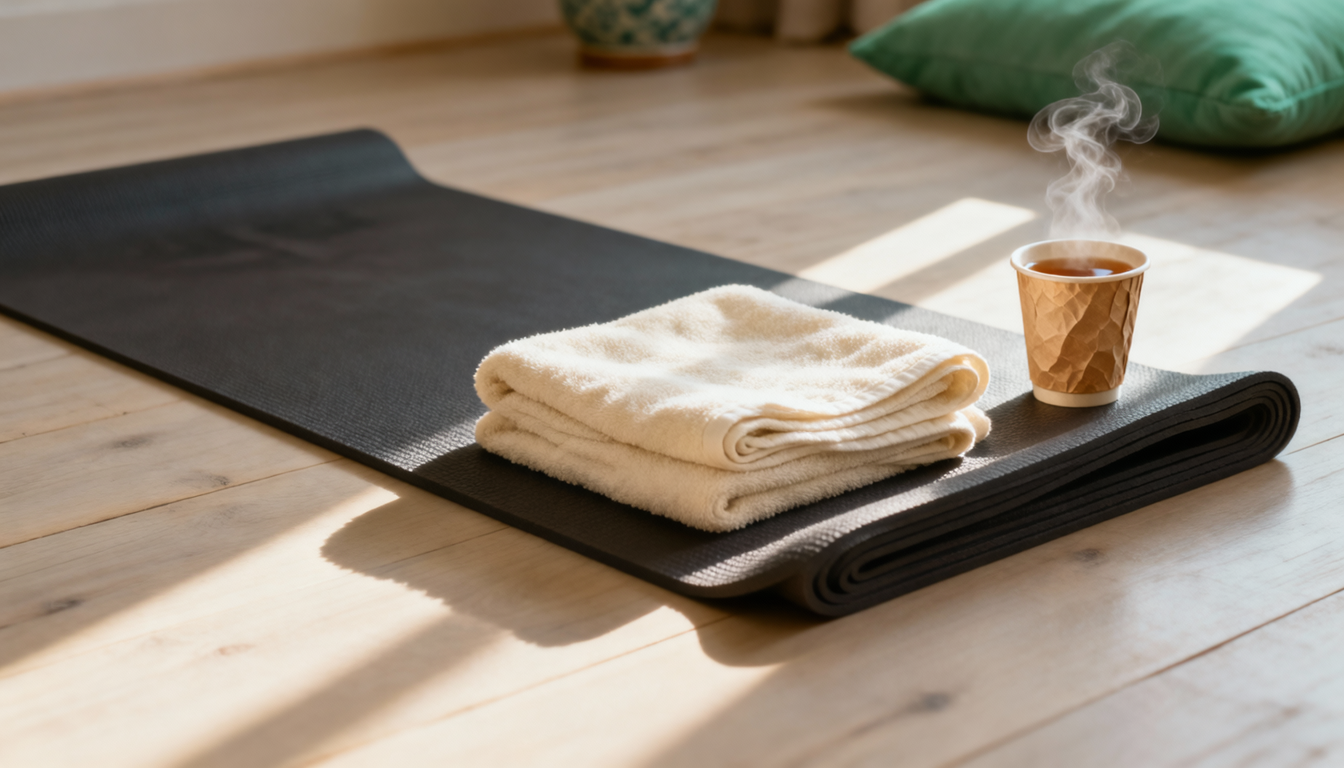
A 10-minute starter (no mat required)
You don’t need a class, a playlist, or a quiet room. You need to slow down and attend to one movement.
Slow spinal roll. Stand, feet hip-width. Inhale and start rolling your spine down one vertebra at a time — feeling each segment move, not just dropping to touch your toes. Exhale and roll back up. Three slow reps. The goal isn’t depth; it’s noticing where the spine feels stuck.
Cat-cow with attention. On hands and knees, move through flexion and extension slowly, syncing breath to movement. Don’t force the range — the instruction is to sense the spine articulating, one segment at a time, the same cue the pilot study used.
The body scan. Lie down, eyes closed. Spend 90 seconds mentally sweeping from your feet to your head, just noticing where there’s tension, heat, or dull ache — no fixing, no judging. This is pure interoception training: the more you can name, the more your baseline input improves.
Ten minutes, three or four times a week. You won’t feel stronger tomorrow. What you’ll notice over a month is different and more useful: you’ll know when you’re about to hurt something, before it happens.
The one-line version
You spent a decade learning to make your body obey. The missing piece is learning to listen to it — because the lifter who can feel the difference between “sore” and “strain” is the one who’s still lifting ten years from now, injury-free.
Strength gets all the trophy photos. Awareness is what keeps you in the game long enough to collect them.
Sources
- Lara, Hamel & Anderson (2025), Journal of Bodywork and Movement Therapies. — a 10-week somatic movement pilot (n=15, mean age ~73) produced a significant improvement in spinal mobility (Back Performance Scale −0.86, p=.005), while body/posture-awareness scores stayed flat — evidence that somatic practice builds measurable mobility though no “feeling” benefits were detected.
- Frontiers in Psychology (2024) — interoceptive awareness in clinical contexts. — somatic/interoceptive practice engages the parasympathetic “rest and recover” response, reducing the stress-load that keeps chronic activation and tension elevated.
- Thomas Hanna, Clinical Somatic Education. — the foundational method (also carried by Essential Somatics®): pandiculation and slow, internally-attended movement to repattern habituated tension and chronic contraction rather than stretch against it.