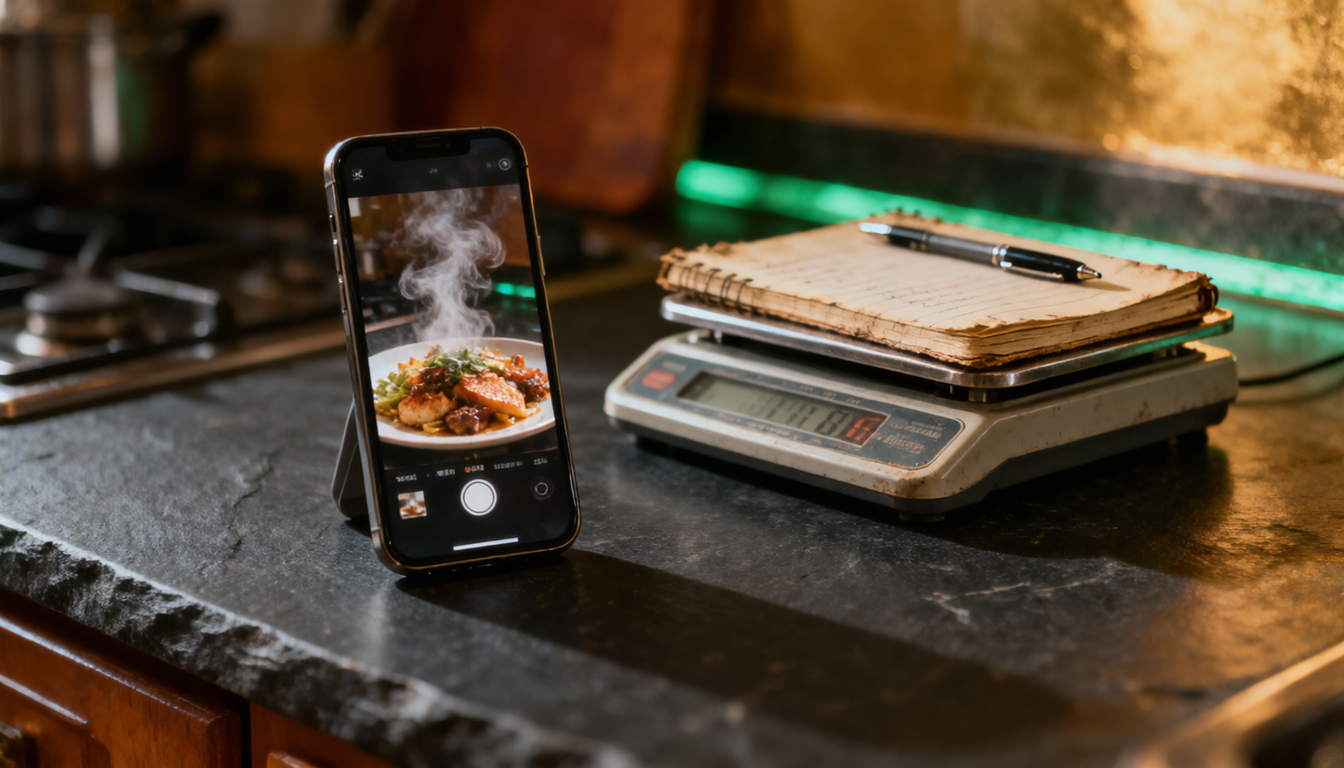
Every tracking method works in the first three days. That’s the trap. You download the app, you weigh the chicken, you type in the rice, you feel virtuous — and then Tuesday afternoon hits, you’re out of the house, you grab a sandwich from a shop you don’t recognize, and the whole system quietly dies by Thursday.
The question has never been “does tracking work.” It works — dozens of studies confirm that self-monitoring is one of the strongest predictors of weight loss. The question is whether the method survives your actual life.
That’s the real fork in the road, and it divides into two camps: manual logging — the weighing, the searching, the tapping — and photo tracking — point the camera, get the numbers. Both claim to be the answer. Only one has a realistic shot at becoming a habit instead of a two-week project.
The villain isn’t the food. It’s the friction.
Most tracking advice assumes you live in a kitchen with a food scale, a quiet few minutes before every meal, and the patience to look up “chicken breast, grilled, 150 g” in a database that has forty-three entries for it, seven of them wrong.
Reality is messier. You eat lunch at a desk. You eat on the run. You eat food someone else prepared, from a menu you didn’t design, in portions you didn’t measure. The moment the act of logging costs more than a few seconds, it starts losing to everything else competing for that moment.
This is the core insight the tracking debate usually skips: adherence is a function of effort, and effort is a function of friction. A method that’s 100% accurate but takes four minutes per meal will be abandoned. A method that’s 85% accurate but takes four seconds will still be running a month from now.
Accuracy is worthless if it’s applied on only three days out of thirty.
Manual logging: the gold standard that most people can’t hold
Let’s be fair to the calorie counter first, because it earned its reputation.
Manual logging — weighing food and entering it gram by gram — is the most accurate method we have. When you log manually and well, your intake estimate is as close to reality as consumer tools can get. For a dieter who genuinely needs precision — a competitive bodybuilder peaking for a show, someone with a very narrow deficit to hold — there is no substitute. See our guide to structuring a real cut.
The problem is what “well” costs. Weight-everything tracking demands:
- A scale, a phone, and both hands free at every meal
- Knowledge of the database’s quirks (that “chicken breast” entry might assume raw weight, cooked weight, or include skin)
- The willingness to break down a mixed dish into its components — the oil, the sauce, the hidden fat — which is where almost everyone’s estimate silently fails anyway
The research on this is uncomfortable. People manually logging their food still under-report by roughly 30–50% — not because the tool is bad, but because the human is the weakest link. We forget the oil. We round down. We skip the days we’re ashamed of. The very precision the method offers collapses the moment the person holding the phone is tired, busy, or slightly embarrassed by what’s on the plate.
So manual logging is a paradox: it’s the most accurate method in the lab, and one of the least survivable methods in a normal life. It’s a professional tool asked to do an amateur’s job.
Photo tracking: the trade nobody explains honestly
Photo tracking flips the equation. Instead of you translating food into numbers, you hand the camera the food and let the recognition model do the heavy lifting. One photo, and the macros come back.
The value is obvious, and it’s not really about accuracy. It’s about removing the decision to log. When logging is “weigh, search, tap, tap, tap,” you make a small willpower withdrawal at every meal. When it’s “tap the camera,” there’s almost nothing to decide — and habits only form where the behavior is nearly effortless.
That’s the mechanism that actually predicts continued use. Habits don’t form in the moments you’re motivated; they form in the moments when the behavior costs almost nothing. A tracking method that survives the bad Tuesday is worth more than a perfect method that only exists on Sundays.
The honest tradeoff is accuracy. Photo recognition is good and getting better, but it’s not a gram scale. It can undercount a drizzle of sauce or misread a portion. For most people, though, that error is smaller than the error they’d make by estimating manually — and it’s applied every day instead of three days a month. An 85% accurate log that runs daily beats a 100% accurate log that died in week two. That’s not a deflection; it’s arithmetic.
Which actually sticks?
Both camps have their believers, and the answer genuinely depends on who you are:
Manual logging sticks when your life is structured — you prep your own food, you eat at home, you have the headspace for the routine, and you need the precision because your goals are extreme. If you’re a competitor or a meticulous planner, the scale is your tool and you’ll defend it rightly.
Photo tracking sticks when your life is average — you eat out, you travel, you’re busy, and your real enemy is not a 40-calorie error but a system you abandon after ten days. For the man who keeps quitting tracking, the fix isn’t more accuracy. It’s less friction.
The pattern that matters: the best method is the one you’re still using in month three. Every tracking failure shares the same ending — not “the numbers were wrong,” but “I stopped.” The method that survives your bad weeks is the one that worked.
So choose the tool for the life you actually live. If you’ve tried weighing and typing and watched it collapse by Thursday, don’t blame your discipline — fix the friction. A photo-based tracker that reads the meal for you, GainCut turns “log my food” into “point the phone at my plate,” so the reason you stopped is gone before it starts.
Sources
- Self-monitoring predicts weight loss — self-monitoring of dietary intake is among the most consistent predictors of successful weight loss and long-term maintenance across behavioral weight-loss trials (Burke et al., 2011 meta-review).
- Under-reporting despite manual logging — doubly-labeled water and biomarker studies consistently find self-reported energy intake under-estimates true intake by ~30–50% on average, an error rooted in human estimation rather than tooling (Schoeller; Lichtman et al., NEJM 1992; Archer et al., 2013).
- Habit formation and effort — behavior becomes automatic when it is easy and repeated in a stable context; the cognitive effort of the behavior, not motivation, is the primary barrier to automaticity (Lally et al., 2010, European Journal of Social Psychology).
- Adherence over accuracy — for most dieters, continued engagement with a less-precise method outperforms a high-precision method abandoned early; the effective intervention is the one sustained (behavioral weight-loss literature, long-term follow-up reviews).