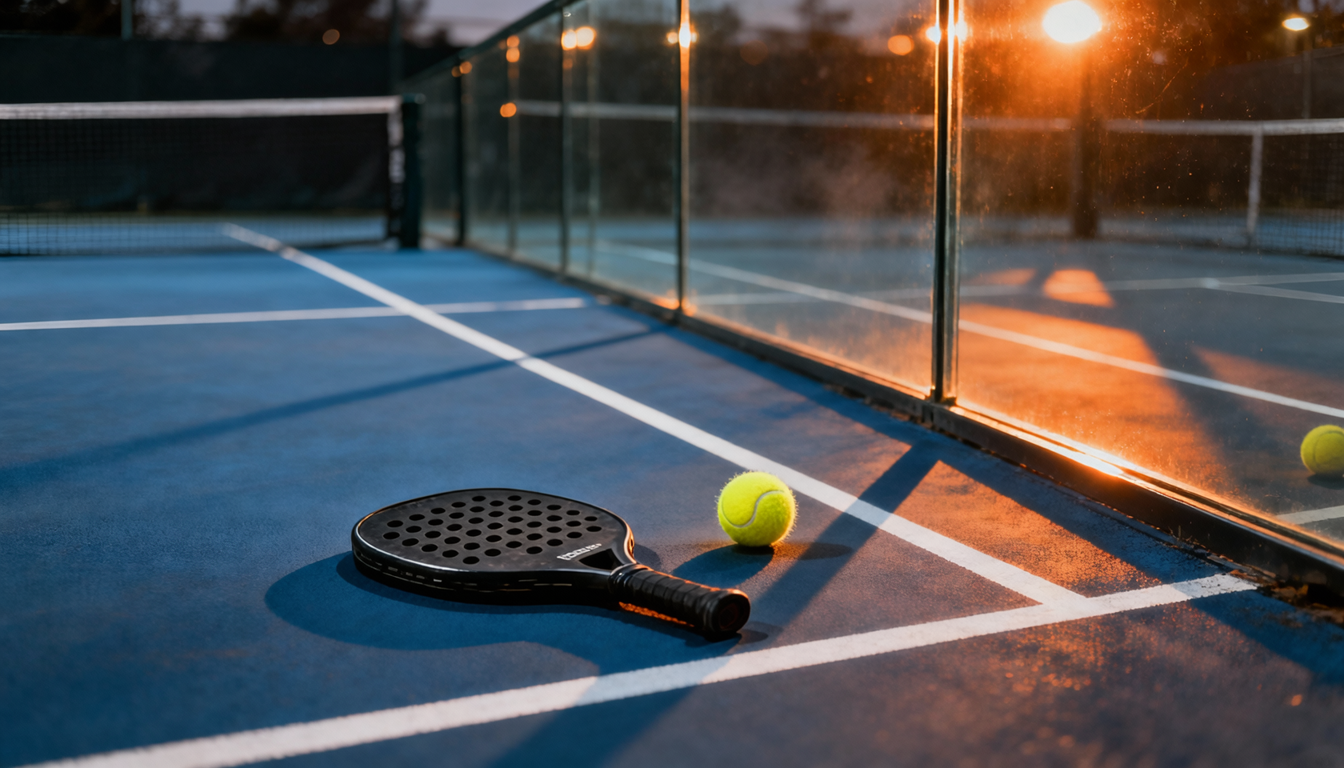
You get invited to a padel game. Somebody at work booked a court, or your brother-in-law has been going on about it for months. You go. You’re terrible at it, which is fine, but also — you can hold a rally. Within an hour you’re sweating properly and having actual fun.
Three weeks later you’re playing three times a week. Eight weeks later your elbow hurts when you lift a coffee cup.
The natural explanation is I’m 42 and my body can’t take this any more. That explanation is wrong, and the research on this specific sport is unusually clear about why.
What the injury numbers actually say
Padel has been played at scale in Spain for two decades, so unlike most new sports it arrives in Asia carrying real epidemiological data rather than marketing copy.
The systematic review published in BMJ Open Sport & Exercise Medicine (2023) pooled eight studies and 2,022 participants. Injuries turned up at a rate of 3 per 1,000 hours of training and 8 per 1,000 matches, with reported prevalence ranging from 40% to 95% depending on how you count and over what window. The elbow was the most frequently injured site, followed by the knee, shoulder and lower back. The injuries were predominantly tendinous and muscular — overuse, not collisions.
A Swedish cohort of 457 players is more useful still, because of who was in it: median age 42, and 66% men. That is not an extrapolation from college athletes. That cohort recorded 185 injuries across 167 players in a single year — 36.5% of players injured annually — with a median recovery time of 30 days.
Read those two numbers together and the shape of the problem appears: about one in three players gets hurt each year, and when they do, they lose a month.
The strongest predictor is not your age
Here is the finding worth the whole article. In the padel literature, the factor most consistently associated with injury is load — how many hours you play, how many sessions a week, and how quickly you added them — and the research is explicit that age and sex are not the primary drivers.
That is not a comforting platitude. It is a statement about mechanism. A tendon does not fail because it has existed for 42 years. It fails because the demand placed on it rose faster than its capacity to adapt. Tendons adapt on a slower clock than muscle, and much slower than enthusiasm.
And padel has a specific problem built into its design. The sport is genuinely easy to start — beginners hold rallies in their first session, which is exactly why it spreads through group chats so fast. Compare that to tennis, where your first six months are mostly collecting balls. Padel skips the natural brake. The sport feels like it requires less from you than it does, so you add sessions faster than your connective tissue can keep up.
The evidence is blunt about the result: injury rates rise with weekly hours and playing intensity, and the pattern that produces them is going from nothing to three or four sessions a week within a month.
Why the elbow, specifically
Padel is a unilateral, overhead, repetitive-swing sport. You play doubles, which means many short high-intensity efforts rather than long slow ones, and the majority of your shots are struck with one arm while the other hand is only briefly on the paddle.
Two consequences follow:
The stroke itself loads the elbow tendon. The backhand is where recreational players get hurt, because an unstable wrist at contact puts the load on the tendon rather than the forearm muscles. Skilled players keep the wrist extended and stable through impact. Beginners don’t, and no amount of being generally fit fixes a technical fault.
Your dominant side runs ahead of your other side. Years of one-sided swinging builds strength asymmetry in the upper limb, and the padel literature names this as a factor in overuse injury and in players abandoning the sport. Grip strength in particular takes a hit during intensive padel play — one study measured measurable grip decrements after simulated matches, larger in men than in women.
The strength work that closes the gap
The prevention prescription in the padel research is not exotic and it is not long. The consistent recommendation across these papers is two short strength and conditioning sessions per week, targeting the structures that padel actually loads:
- Calves — heel raises, double then single leg. Calf injuries are common in players over 35, and the court demands constant small push-offs.
- Legs and hips — squats, lunges, step-ups. Knee control for the change of direction the glass walls force on you.
- Rotator cuff and shoulder blade — band work. This is what protects the overhead.
- Grip and forearm — wrist extension work, which is what protects the elbow.
- Core and trunk rotation — the review recommends core stabilisation and trunk strength specifically for avoiding injuries with long-term consequences in a unilateral overhead sport.
That is a general strength programme wearing a padel jersey. Which is the point: the training that keeps you on court is the same training that keeps you independent at 70. You are not doing padel-specific preparation. You are buying tendon capacity faster than the sport can spend it.
The practical version
Three rules, in order of how much they matter:
1. Cap the weekly jump, not the weekly total. Going from one session to two is fine. Going from zero to three in a month is the exact pattern the injury data describes. Add a session, hold it for a few weeks, then add another.
2. Start the strength work in week one, not week six. The common sequence is play until something hurts, then start rehabbing. Reverse it. Two sessions a week from the beginning, and you never give the tendon a reason to complain.
3. Take the warm-up seriously, because nobody does. Load the shoulder with band work before your first overhead, and don’t make your first bandeja of the day a full-power one. Both the epidemiological reviews and the coaching literature name this as the single most skipped item.
What this means for the decade
There is an obvious joke here about racket sports and middle age, and it’s the wrong frame. The point is not that you should be careful. The point is that padel rewards exactly the behaviour this whole site argues for: a load you can sustain for years beats a load you can survive for six weeks.
The players who will still be on court at 60 are not the ones who were most talented at 42. They are the ones who kept their weekly hours inside what their tendons could absorb, added strength work before it was necessary, and treated the first twinge as data rather than as an obstacle to push through.
Padel is genuinely good for you. It is continuous movement, it forces change of direction, it is social in a way that gym training never is, and its short rallies make it real conditioning. All of that is why it spreads. The injury data is not an argument against playing. It is an argument for adding sessions slowly.
Sources
- Incidence, prevalence and nature of injuries in padel: a systematic review. BMJ Open Sport & Exercise Medicine 2023;9:e001607. PMID 37337550 · PMCID PMC10277135
- Injuries and risk factors in Swedish padel. ScienceDirect S0949328X22002605 — n=457, median age 42, 66.1% men, 36.5% annual injury incidence, median recovery 30 days
- Match Analysis, Physical Training, Risk of Injury and Rehabilitation in Padel: Overview of the Literature. PMCID PMC8998509
- Ball Impact Position in Recreational Male Padel Players: Implications for Training and Injury Management. PMCID PMC7828082
- Padel related injuries: prevalence and characteristics in Chilean amateur players. PMCID PMC12220762
Related on traindecade: why a decade beats a six-week challenge, how to start training over 40, and zone 2 — the engine you build by not sprinting.