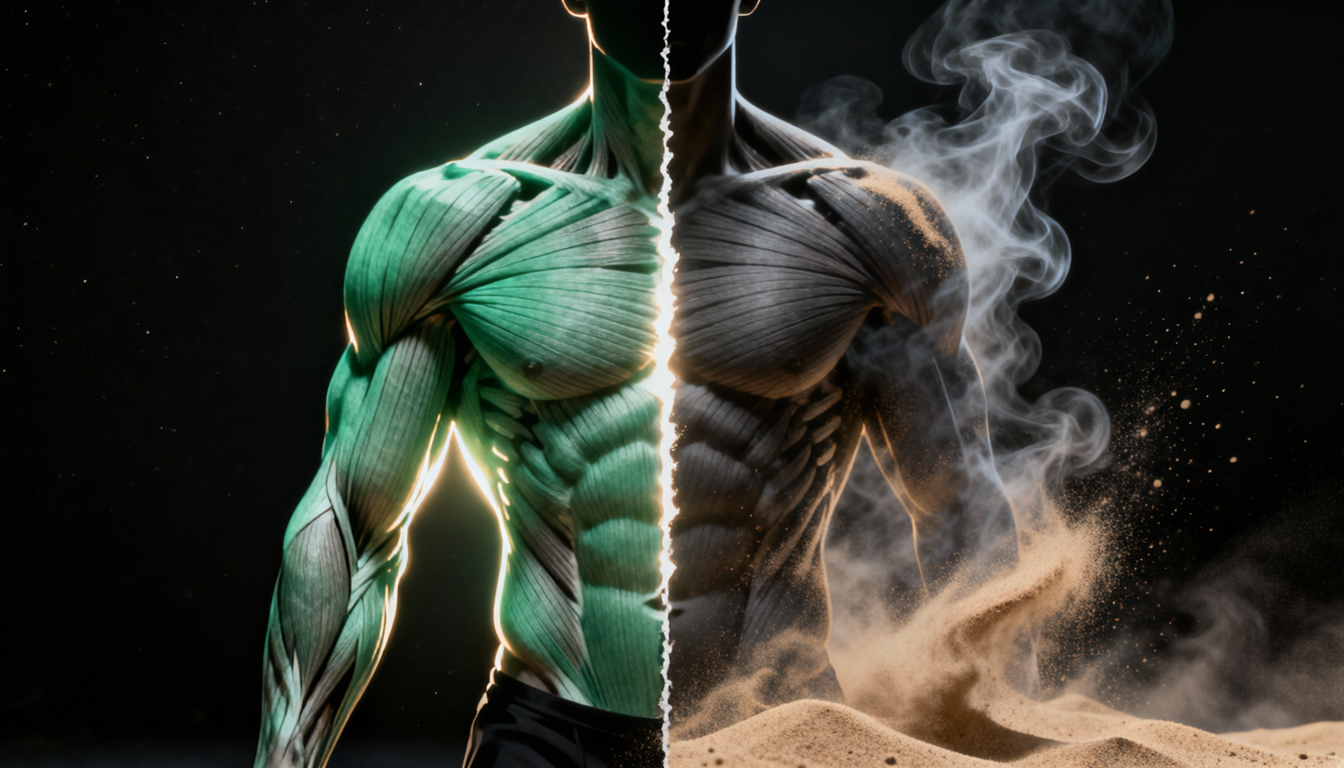
Here’s the quiet problem with almost every weight-loss success story: the scale drops, the clothes fit, and nobody asks what was actually lost.
Fat, sure. But almost always muscle too. The scale can’t tell the difference. It reports one number — and that number is lying to you about which of the two you just spent.
For men over 40, this isn’t a minor detail. Muscle is the asset you can’t afford to lose: it’s what burns calories at rest, keeps your joints stable, and decides whether you age into strength or frailty. Lose it during a cut, and you arrive at “goal weight” looking smaller and feeling weaker — with a slower metabolism that’s primed to put the fat right back on.
So the real question isn’t “how do I lose weight.” It’s the one almost nobody asks out loud: how do I lose the fat and keep the muscle?
The answer is more within your control than the fitness industry wants you to think. And the research is remarkably consistent.
Why fast weight loss burns muscle
When you cut calories hard, your body doesn’t just tap fat stores. It breaks down anything it can for energy — and muscle is metabolically expensive to keep, so it’s first on the chopping block.
This isn’t a bug in fad diets. It’s the biology of any calorie deficit. Older calorie-restriction studies put the muscle share of weight loss at 20–50% depending on how steep the cut is. Crash hard, and you’re burning almost as much muscle as fat.
The warning signs are the same everywhere, and they all trace back to two dials you can actually turn.
The two dials that decide everything
Dial one: resistance training. This is the heavier hammer. The Physical Activity Working Group of the European Association for the Study of Obesity has been explicit — it’s resistance exercise, not cardio, that blunts muscle loss during weight-loss diets. Cardio is good for your heart. It does not preserve muscle. Two to three strength sessions a week for the months you’re in a deficit is the difference between melting fat and slowly spending your metabolism.
Dial two: protein — up, not down. When calories drop, protein is the first thing to vanish from the plate, and it’s the one macro your muscle needs most when food is scarce. The working number during weight loss is 1.2–1.6 g of protein per kilogram of body weight per day — substantially more than the 0.8 g/kg a sedentary person needs. For an 80 kg man, that’s 96–128 g a day, often a fight when you’re not hungry, and the most common reason the muscle-loss number creeps up.
Get those two right and you’ll lose fat predominantly. Ignore them and the scale will cheer you on while your engine idles down.
What the latest evidence shows — the GLP-1 story
Nothing has made this conversation more urgent than the GLP-1 drugs of the last few years. And they’re the cleanest demonstration of the principle, because they finally made rapid weight loss reliable — which forced the muscle question into the open.
Look at the body-composition data and the pattern is unmistakable:
- In STEP-1 (semaglutide), lean mass dropped 9.7% while fat dropped 19.3% — fat loss dominated so much that muscle’s share of the body actually went up.
- In SURMOUNT-1 (tirzepatide), ~25% of the weight lost was lean mass and 75% was fat.
- The SEMALEAN study followed patients for a year and found lean mass dipped about 3 kg by month 7 — then stabilised — while grip strength actually improved 4.5 kg, and the share flagged with “sarcopenic obesity” fell from 49% to 33%.
Read that last line again: people didn’t just lose weight — they became less frail by any functional measure.
But a review in Circulation put the lean-mass share of GLP-1 weight loss at 20–50%, depending on dose, population, and what the person did while losing. That range is the whole point. The drug doesn’t decide whether you lose muscle — your training and protein do. The injection removes one obstacle (hunger), but it doesn’t lift, and it doesn’t repair. That part was always yours.
The same biology applies whether the deficit comes from a needle, a crash diet, or surgery. Fast weight loss from any cause spends some muscle. The question is just how steep, and what you do on the way down.
What to actually do
Here’s the whole playbook, without the noise:
- Lift 2–3 times a week. Compound movements — squat, press, row, hinge. The single biggest lever on keeping muscle.
- Hit 1.2–1.6 g/kg of protein daily. Plan it; low appetite won’t let you stumble into it. (See our protein guide for the math.)
- Lose slowly, not fast. Aim for 0.5–0.8% of body weight a week. Slower cuts preserve more lean mass.
- Track the trend, not the day. A tape measure (fat) and your main lifts (muscle) tell you more than the number on the scale.
The people who lose fat and keep muscle aren’t lucky or genetically gifted. They just treat weight loss as a two-track job — cut the calories, feed the muscle — instead of a one-track sprint.
Because a decade from now, nobody will ask how fast the weight came off. They’ll ask what it left behind.
And to actually run that two-track job, you need the intake side nailed down, not guessed. If you’re not already logging, don’t do the math by hand — use a tracker that reads the meal for you. GainCut turns a plate into a protein-and-calorie breakdown from one photo, so the “feed the muscle” half is measured, not hoped for.
Sources
- Wilding JPH, et al. Once-Weekly Semaglutide in Adults with Overweight or Obesity (STEP-1). N Engl J Med. 2021. — lean mass −9.7% vs fat −19.3%.
- Jastreboff AM, et al. Tirzepatide Once Weekly for the Treatment of Obesity (SURMOUNT-1). N Engl J Med. 2022. — ~25% of weight lost as lean mass.
- Alissou M, et al. Impact of Semaglutide on fat mass, lean mass and muscle function: The SEMALEAN study. Diabetes Obes Metab. 2026;28(1):112–121. (PMC12673431) — lean −3kg @7mo then stabilised; grip +4.5kg; sarcopenic-obesity 49%→33%.
- Linge J, et al. Muscle Mass and GLP-1 Receptor Agonists. Circulation. 2024. — lean mass 20–50% of total weight loss.
- EASO Physical Activity Working Group (2024) — resistance training, not aerobic, attenuates lean mass loss during weight-loss diets.
- “Muscle loss and GLP-1R agonists use” (PMC12957034) — protein 1.2–1.6 g/kg/day during weight loss.