Ask ten people how much protein you need and you’ll get ten numbers, each delivered with total confidence. On one side: the “one gram per pound” crowd, quoting gym-locker geometry. On the other: the “bro-science is a myth” crowd, pointing at an official guideline so conservative it was designed for sedentary survival, not muscle.
Both are wrong in a way that’s actually convenient for you to hear, because the real answer is a single number that the research keeps landing on — and it’s less than the bros insist and far more than the skeptics admit.
The evidence-backed dose for building muscle is about 1.6 grams of protein per kilogram of body weight per day. For a man at 80 kg (176 lb), that’s roughly 128 g a day. Past that point, extra protein stops meaningfully adding muscle and just becomes expensive calories. Below it — especially as you get older — you’re leaving gains on the table.
One caveat before you take 1.6 as gospel: the figure is calculated against total bodyweight, which is a simplification. Protein targets scale with lean mass — the muscle, bone, and organ tissue doing the work — not with fat. So if you carry a lot of body fat, the total-weight figure overshoots what you actually need, and a leaner man at the same weight needs more. For most readers inside a normal range the difference is small. If your midsection carries obvious weight, run the numbers against your lean mass instead. (The protein target calculator below does that adjustment for you and shows its working.)
Why the two competing numbers are both wrong
The “one gram per pound” rule is gym-locker folklore, not science. It was born from a convenient rounding, repeated so often it calcified into certainty. The actual research plateau — the dose beyond which adding protein doesn’t build more muscle — lands around 1.6 g/kg/day (or, said the American way, about 0.73 g per pound). The 1g-per-pound crowd is recommending roughly 35% more protein than the evidence says does anything.
That’s not harmless. Excess protein isn’t toxic, but it crowds out the foods that matter — and it makes a supposedly simple plan feel like a chore, which is how people quit.
The other extreme — the official RDA of 0.8 g/kg/day — is a genuine number with a genuine purpose: it’s the minimum to avoid deficiency in a sedentary adult. It was never meant to be a target for someone trying to build or hold muscle. Citing it as “science says you’re fine” is how people convince themselves that their shrinking muscle mass is just age. It’s a floor, not a ceiling — and for the over-40 trainer, it’s a lowball that costs you muscle every year you follow it.
Why the number matters more after 40
Here’s the thread that ties this to every other decade-scale argument you’ll read on this site: protein gets more important with age, not less.
Two mechanisms drive it. First, aging blunts the anabolic response — the same protein dose triggers less muscle synthesis in a 55-year-old than a 25-year-old. Second, many people eat less protein as they age, precisely when they need more. The result is the slow, almost imperceptible creep of sarcopenia: the loss of muscle that drags strength, balance, and bone health down with it over decades.
The fix is boring and specific: aim for the 1.6 g/kg/day end of the range, distributed across your meals (the synthetic response is dose-sensitive — a bolus of 0.4 g/kg per meal, roughly 25–40 g, reliably maximizes it). The over-40 lifter who does this closes most of the “age gap” in muscle-building.
What that looks like on a plate
Forget the supplement-store theatrics. The math is simpler than the industry wants you to think:
- 80 kg man → ~128 g/day, or ~40 g across three meals (plus a little extra).
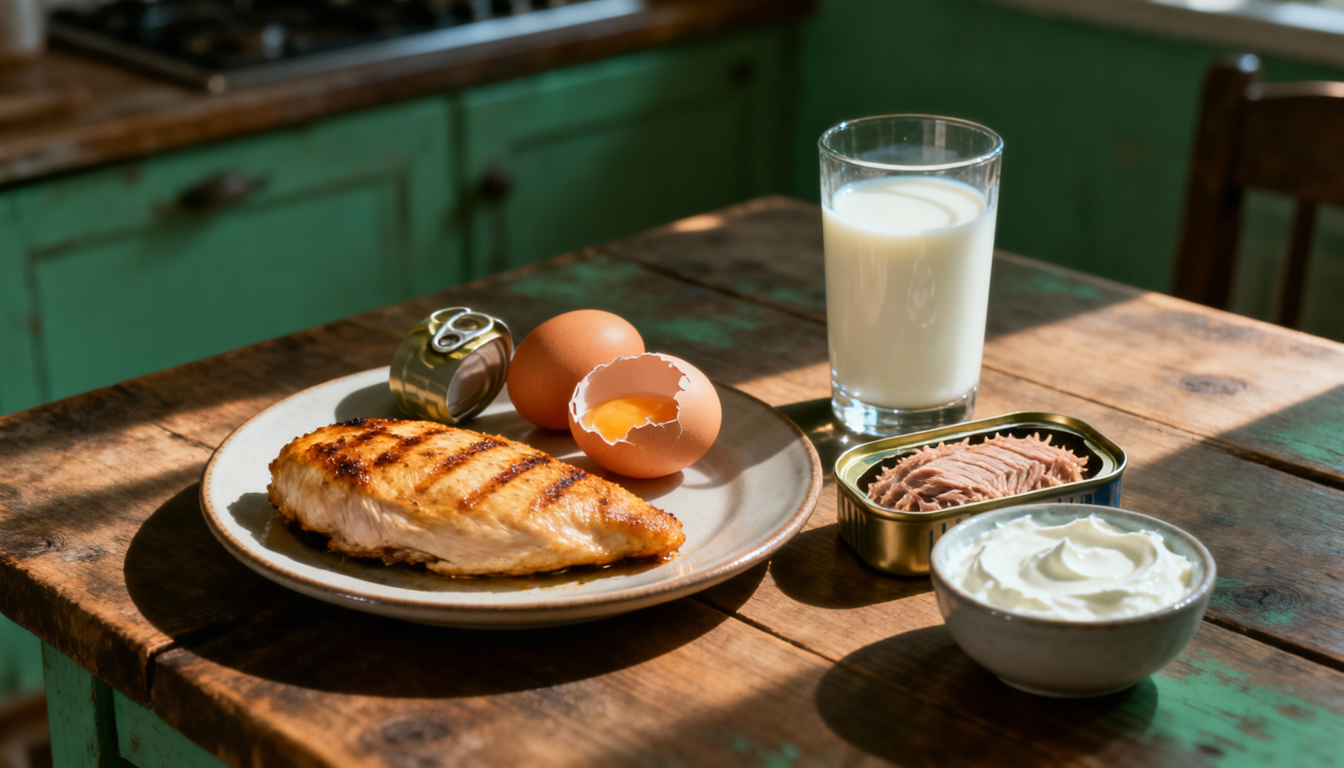
- That’s a palm of chicken (~30 g), two eggs (~12 g), a scoop of whey or a Greek yogurt (~20–25 g), a tin of tuna (~25 g), a serving of beef (~35 g). You don’t need a spreadsheet — you need roughly a palm-sized protein source per meal, three times a day.
Whole foods beat powders — not because powders are bad, but because food carries the micronutrients, satiety, and habit you’re actually building a decade on. A scoop of whey is a fine gap-filler, not a strategy. (Want a system for hitting the number without cooking every day? See Easy Protein Meal Prep. If you’re deciding which powder to buy, the evidence — including why the “best protein” ranking keeps changing depending on how long you measure — is in Whey vs Soy vs Casein vs Pea.)
The decade framing
Nobody’s muscle mass collapses because they aimed 10 g under their protein target one Tuesday. The damage is the decades spent at the RDA, thinking 0.8 g/kg was “science-approved” while muscle quietly receded.
A man at 45 who eats 1.6 g/kg and trains two to three times a week isn’t doing anything dramatic. He’s just removing the single most fixable reason men his age lose muscle — and letting the training actually work.
Protein isn’t magic. It’s the raw material. Get the dose right and the boring consistency actually compounds; get it wrong for years and no amount of effort in the gym fully lands.
Run your own numbers
Protein Target Calculator
Work out your daily protein target from your bodyweight, goal, and body composition. The answer shows instantly, and we don't ask you for anything.
Between 30 and 300. Switch between kg and lb freely.
This sets your lean-mass basis, which adjusts the target.
Based on the 1.6 g/kg evidence threshold.
A general adult reference, not medical advice. If you have kidney or metabolic conditions, talk to your doctor.
Sources
- Morton et al. (2018) — “A systematic review, meta-analysis and meta-regression of the effect of protein supplementation on resistance training-induced gains in muscle mass and strength in healthy adults.” Protein intakes beyond ~1.6 g/kg/day produced no further benefit.
- Bagheri et al. — Untrained older adults supplementing toward ~1.6 g/kg/day gained significantly more lean mass and strength over 8 weeks than those at ~0.8 g/kg/day — evidence the higher dose matters specifically for older trainees.
- Anabolic resistance with age — Older adults show a blunted muscle-protein-synthetic response per unit of protein, which is partially overcome by higher per-meal doses (~0.4 g/kg, or ~25–40 g) and higher total daily intake.
- RDA context — The 0.8 g/kg/day Recommended Dietary Allowance is defined as the minimum to meet needs in 97–98% of sedentary adults, not a target for muscle maintenance or gain.