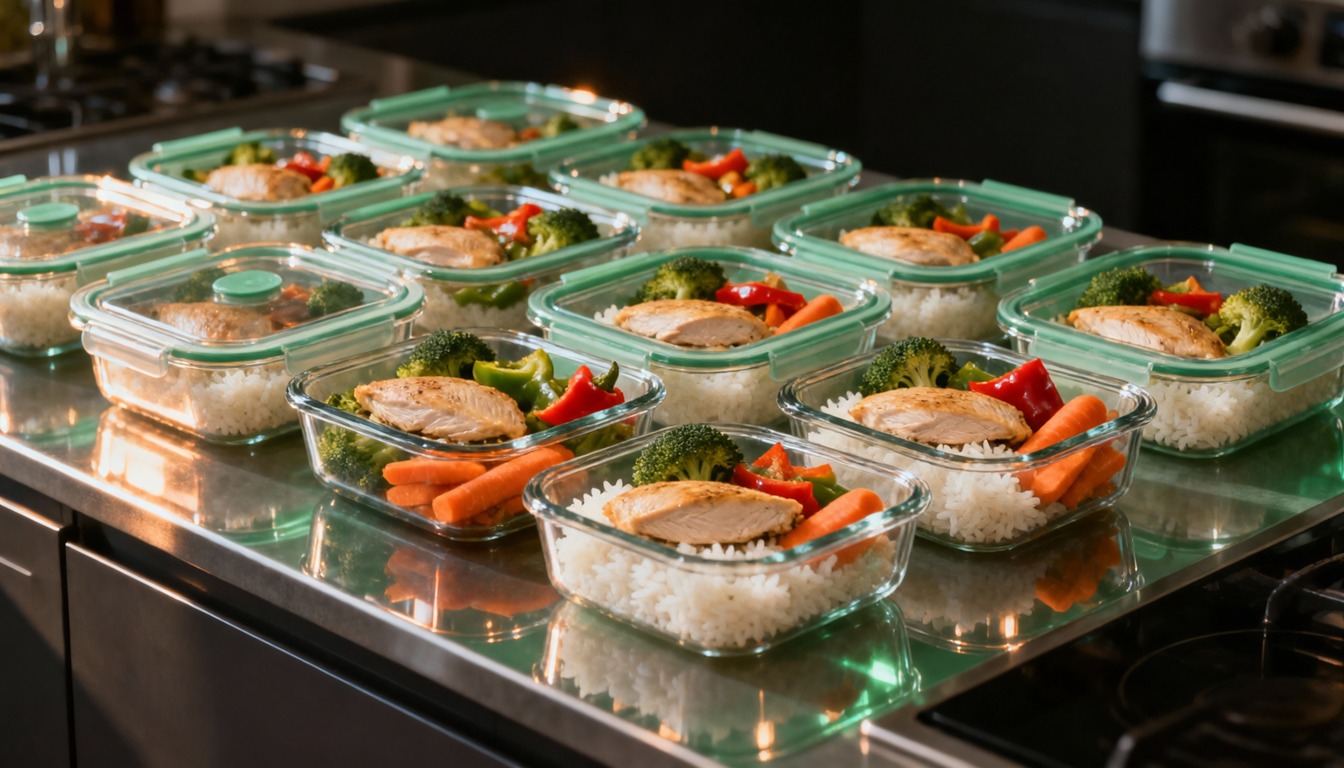
You’ve seen the number: roughly 1.6 grams of protein per kilogram of body weight, every day. Knowing it is easy. Eating it — consistently, without living in the kitchen or burning out — is where most men quietly fail.
This is the missing half of the protein conversation. Not another lecture on how much, but a dead-simple system for how to actually do it: a batch-cook session once or twice a week, a few flexible formulas, and no daily cooking required.
The goal isn’t gourmet. It’s repeatable enough to survive a decade.
The principle: cook once, eat many times
Every other meal-prep “hack” flows from one idea. Protein is the bottleneck, and protein foods are the most predictable thing to batch. So you front-load the effort:
One 60–90 minute session, once or twice a week, produces all your protein for coming days. Chicken breast, lean beef or pork, eggs, fish, Greek yogurt, cottage cheese — all batch beautifully, all reheat (or get eaten cold) with zero drama.
The man who batch-cooks on Sunday and Thursday never has to think about protein on Tuesday. The man who tries to cook every day eventually orders takeout — and that’s where the protein target dies.
The formula, not the recipe
You don’t need a recipe app. You need three repeatable formulas you can run with whatever’s cheap at the market:
1. The batch protein base. Pick two sources, cook a large batch of each. Example: 1 kg of chicken breast (seasoned, baked at 200°C for ~20 min) + 800 g of lean ground beef (browned with onion and garlic). That single session yields ~6–8 meals of protein.
2. The 3-ingredient plate. Every meal becomes: protein + a carb + a vegetable. Chicken + rice + broccoli. Beef + sweet potato + green beans. Greek yogurt + berries + oats. You’re not following a recipe — you’re assembling from a stocked fridge.
3. The no-cook fallbacks. For the days you don’t even want to microwave: tinned tuna, Greek yogurt, cottage cheese, whey in milk, boiled eggs. These are the gap-fillers that keep you on target when life happens — and the reason the system survives contact with a busy week. (Not sure which powder is worth buying — whey, soy, casein, pea? The full comparison is here, including why the “best protein” ranking keeps flipping depending on how long you measure.)
An 80 kg man’s sample day (~130 g)
This isn’t a diet plan, just proof the math is easier than it looks:
- Breakfast: 3 eggs + Greek yogurt (~35 g)
- Lunch: batch chicken + rice + veg (~40 g)
- Snack: whey shake or cottage cheese (~25 g)
- Dinner: batch beef + sweet potato + greens (~35 g)
Total roughly 135 g — over the ~128 g target for 80 kg. And notice: every component except the vegetables came out of a batch or a can. No daily cooking, no decisions, no willpower.
The traps (and how the system dodges them)
Trap 1 — “healthy food is complicated.” It isn’t; the 3-ingredient plate proves it. Complexity is a rationalization, not a requirement.
Trap 2 — deciding in the moment. Willpower fails at 7pm when you’re tired and hungry. The system removes the decision: the batch protein is already there. You just assemble.
Trap 3 — boredom. Batch prep dies when it’s the same chicken every day. That’s why the system is formulas, not recipes — swap the protein, swap the carb, swap the seasoning, and it’s a different meal with zero new skills.
The decade framing
Nobody fails to hit their protein target because they didn’t know the number. They fail because eating it daily required daily effort, and daily effort decays.
The man who meal-preps twice a week removes the single point of failure — the daily decision — and turns a protein target from a project into a habit. Do that, and the muscle-building training you’re already doing finally has the raw material to work with, day after day, year after year.
Protein is the raw material. Meal prep is the supply line. Build the line once, and the decade takes care of itself.
Sources
- Protein target — Evidence-backed dose of ~1.6 g/kg/day for muscle gain (Morton et al. 2018 meta-analysis; Bagheri et al. in older adults). See the full breakdown in How Much Protein Do You Really Need?.
- Per-meal dose — A per-meal protein dose of ~0.4 g/kg (~25–40 g) maximizes the muscle-protein-synthetic response, which is why the sample day distributes protein across meals rather than in one bolus.
- Batch cooking and adherence — Meal planning and food preparation are consistently associated with healthier dietary patterns and better adherence to nutrition targets; removing in-the-moment food decisions reduces reliance on willpower.