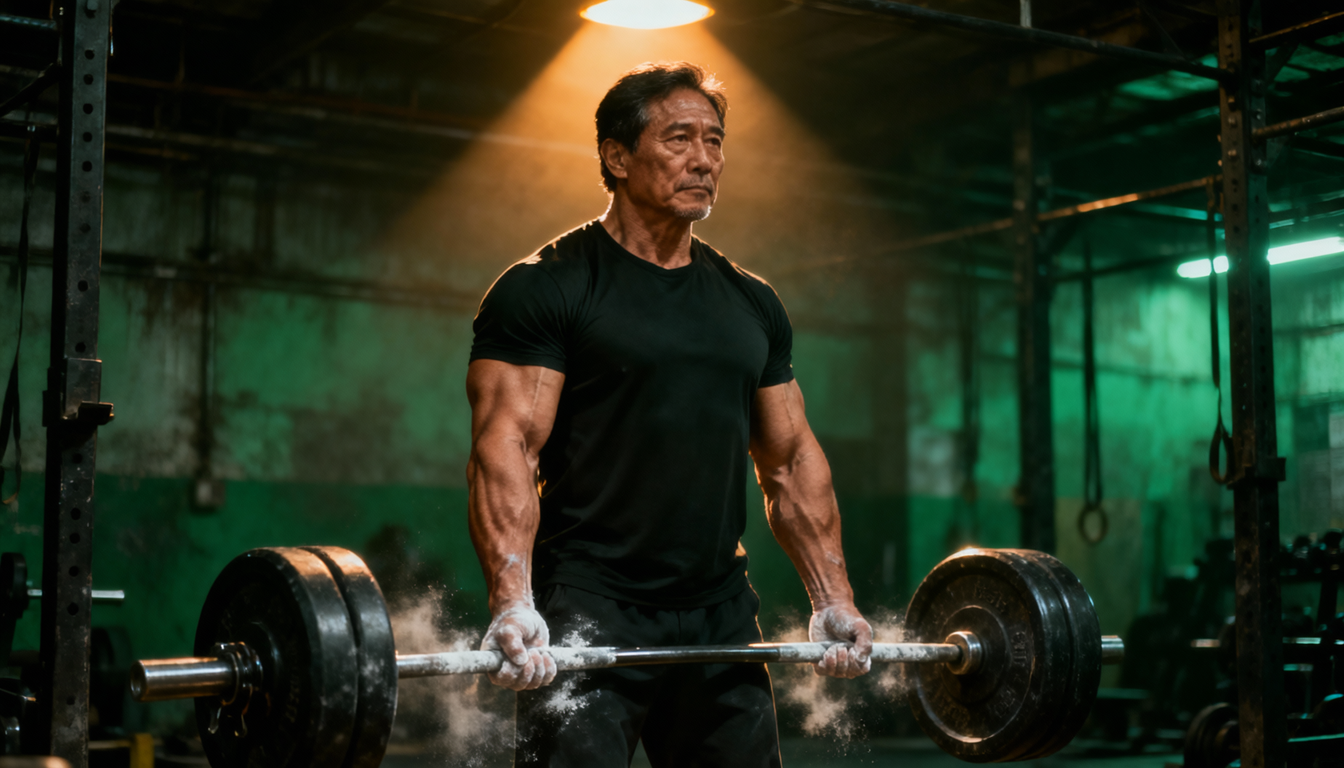
Somewhere around fifty, the fitness industry hands you a script and expects you to read it: your muscle-building days are over. You’re fighting a losing battle against aging. Here, buy this supplement.
It’s one of the most successful fear campaigns in the entire health space — because it tells a story people are primed to believe. And it collapses the moment you look at the actual research.
Can you build muscle after 50? Yes. And not by a little. Untrained men in their sixties and seventies — people the “cliff” story would have you believe are finished — reliably gain serious, measurable muscle. The question isn’t whether it’s possible. It’s why the honest answer makes the fear-marketers so uncomfortable.
The study that kills the cliff
Let’s start with the number that doesn’t care about your narrative. Frontera et al. (1988) took twelve sedentary men aged 60 to 72 — most of whom had never trained — and put them through twelve weeks of supervised resistance training. The results were not subtle: their knee-extensor strength roughly doubled (~107%), and flexor strength roughly tripled (~227%).
Read that again. Strength doubled in three months. In men past sixty.
That, alone, is the entire debate. If muscle-building shut down at 50 — or 60, or 70 — that study could not exist. What an untrained older body actually does when you give it progressive load is the same thing an untrained younger body does: it adapts, dramatically.
What genuinely changes (the honest version)
None of this means fifty is twenty-five. Pretending the two are identical is just the opposite con job — and it sets people up to fail as surely as the fear does. Three things really do shift, and they should shape how you train, not whether you train:
The anabolic response to a single workout is blunted. Give a younger and an older man the same training session, and the older body synthesizes less muscle protein from it in the hours after. That sounds alarming until you see the fix: the older body responds to higher protein doses and consistent training by closing most of the gap. The blunt isn’t a wall; it’s a dial you can turn up.
Recovery takes longer — so you recover smarter. The forty-eight hours of recovery a 30-year-old gets might be sixty or seventy-two at 55. But “recover longer” is a scheduling detail, not a verdict. Spread the same volume across three lighter sessions instead of one brutal one, and the older body rebuilds just fine.
Muscle turns over more slowly, which means consistency matters more, not less. The older your connective tissue and muscle fibers, the more the whole project rewards showing up for years instead of exploding for weeks. This is precisely why the over-50 trainee has an advantage he rarely gets credit for: he’s finally patient enough to run a decade-scale plan instead of a six-week one.
Why the “too old” story sells (and who it serves)
If you’re wondering why a story this easily disproven survives, follow the money. The “past your prime” narrative is the foundation of the entire midlife supplement and anti-aging market. Convince a fifty-five-year-old man his body is in irreversible decline, and you’ve got a customer for life — for testosterone boosters, “T-boosters,” peptides, expensive blood work, and seminars.
The truth — train consistently and your body adapts at any age — is worse for business. It requires no product. It’s free, it’s boring, and it works. That’s why you never hear it shouted.
This is the same shape every traindecade post makes: the villain is the quick-fix industry, the hero is your decade-scale self. And nowhere is that truer than the question of whether fifty is too late. It isn’t.
How to build muscle after 50 (the actual method)
If you’re a 50-year-old man — or 60, or 70 — the method for building muscle is the same foundation as any beginner, with two upgrades for the older body. The research doesn’t switch you to a different rulebook at fifty; it just tunes two dials.
Train 2–3× a week, whole body, progressive load. Squat, hinge, push, pull, carry. Start embarrassingly light. Add 2.5 kg a session. The Frontera result came from exactly this: basic, consistent, progressive resistance — no secrets.
Prioritize protein at the higher end. Because the anabolic response is blunted with age, protein matters more after fifty, not less. The evidence points to roughly 1.6 g per kg of body weight per day outperforming the 0.8 g most people default to. That’s the single most impactful nutrition change for the over-50 lifter. (See How Much Protein Do You Really Need? for the full breakdown.)
Recover on purpose. Sleep isn’t optional. Give yourself full rest days between sessions. The recovery that’s “longer” at 55 is just the same recovery with a real schedule attached.
Fifty isn’t the end of the muscle-building story. It’s the age at which the people selling you decline lose their grip — because the evidence shows, plainly, that a man who starts lifting at fifty-five will be stronger at sixty than the man who spent five years believing he was too old.
The training doesn’t change. The protein doesn’t change. Only the decision does.
Sources
- Frontera et al. (1988) — “Strength Conditioning in Older Men.” Twelve untrained men aged 60–72 gained ~107% knee-extensor and ~227% flexor strength over 12 weeks of resistance training. The foundational evidence that muscle and strength respond to load at any age.
- Anabolic resistance / protein dose — Older adults show a blunted muscle-protein-synthesis response to a single bout of resistance exercise and to small protein doses; higher per-meal protein (and total ~1.6 g/kg/day) partially overcomes it (see also Bagheri et al. on untrained older adults).
- Muscle protein turnover with age — Muscle protein turnover slows with age, raising the relative importance of sustained training frequency and adequate protein over short-term intensity.