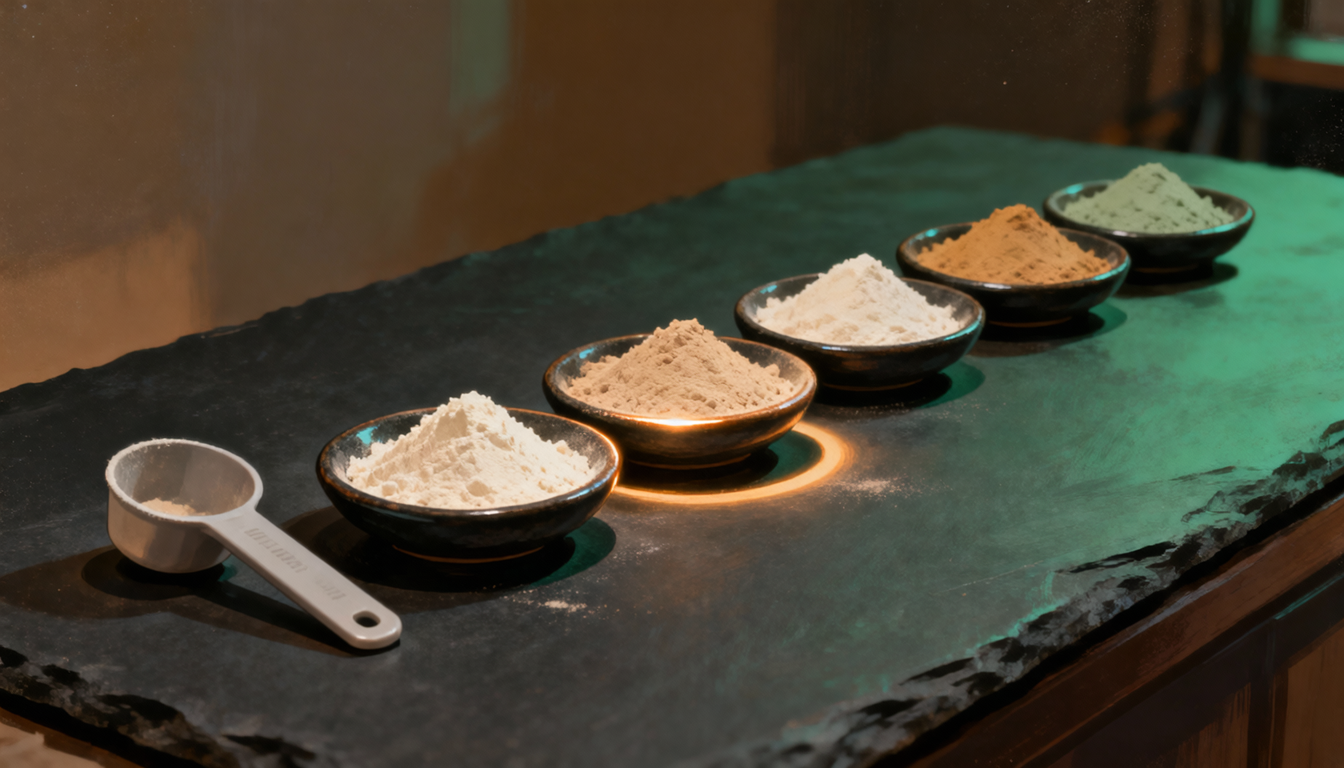
Search “which protein powder is best” and you’ll get a different answer from every page. Whey is the king. No, casein for the overnight window. No, soy is just as good and cheaper. No, pea, because dairy wrecks your gut.
Here’s why the arguments never resolve: they’re ranking proteins on a measurement that changes depending on how long you watch.
Run a muscle-protein-synthesis test for three hours after a scoop and whey wins. Run the same test for six hours and casein catches up. Measure what actually leaves your gut and gets retained, and pea ties milk protein outright. Every one of those studies is real, well-conducted, and correct. They just answer different questions.
Once you see that, the whole “best protein” industry falls away, and what’s left is one amino acid you can count yourself.
Nobody here is selling a tub. The comparison articles that rank highest on this search are published by supplement retailers and dairy marketing boards. This one walks through the actual trials, in both directions, so you can read the primary sources and check us.
The short answer
For building muscle after 40, the type of protein powder matters far less than the total amount you eat. Hit roughly 1.6 g/kg of bodyweight per day from complete protein sources and you’ve captured nearly all of the benefit. The differences between whey, casein, soy, egg, and pea are real but second-order — they affect speed and convenience, not your final physique.
If you want the fast version of the whole post: whey is the default because it has the most leucine and digests fastest. Everything else is a special case. Dairy-free, vegan, budget, overnight — those are legitimate reasons to pick something else. “This one builds more muscle” is not.
Why the ranking keeps flipping
The confusion traces to one experiment design that dominated the field for two decades.
The Tang et al. (2009) study in the Journal of Applied Physiology is the classic. Young men took 10 g of essential amino acids as either whey hydrolysate, micellar casein, or soy isolate, then had muscle protein synthesis measured after leg exercise. Whey won clearly:
Muscle protein synthesis, after resistance exercise
  whey  ████████████████████████  (reference)
  soy   █████████████████        +31% vs casein, -31% behind whey
  casein ██████████              -122% behind whey
Spelled out: whey stimulated MPS about 122% more than casein and about 31% more than soy post-exercise. Soy beat casein by roughly 69%. That’s a big, clean, statistically significant spread — and it’s why “whey is best” became gospel.
Now here’s the problem. Reitelseder et al. ran a similar comparison but extended the measurement window to six hours instead of three. With the longer window, casein produced a muscle protein anabolic response similar to whey. The gap didn’t vanish because casein got better — it vanished because the original window stopped watching before casein finished.
Casein forms a gel in the stomach and releases amino acids slowly. Measure for three hours and you’re measuring whey’s fast peak against casein’s slow ramp — you’ve compared a sprinter to a distance runner at the 100m mark and declared a winner. Neither study is wrong. The “ranking” was never a property of the proteins; it was a property of the stopwatch.
The leaderboard that matters: leucine
Strip away the timing debate and nearly all of this collapses into one amino acid.
Leucine is the trigger. It’s the amino acid that activates muscle protein synthesis (via the mTOR signalling pathway). More leucine, more of a switch. That’s the entire mechanism behind whey’s reputation — whey is roughly 11% leucine by weight, the highest of any conventional animal protein.
But the leucine leaderboard is not what most people assume:
Leucine content, % of protein by weight
  corn protein        13.5%   ← higher than whey
  whey                11.0%
  milk                 9.0%
  muscle protein       7.6%
  pea                  7.2%
  egg                  7.0%
  soy                  6.9%
  canola               6.9%
  casein              ~7-8%
  hemp                 5.1%   ← the actual dud
Two things jump out. First, corn protein out-leucines whey — the “whey is the leucine king” line is only true among the conventional animal proteins people actually buy. Second, hemp protein is the one genuinely poor choice, and it’s rarely the one anybody warns you about.
Gorissen et al. (2018), which compiled these figures, also gave the practical conversion: you need roughly 2.7 g of leucine per serving to maximise the MPS response. Depending on the source:
To reach ~2.7g leucine:
  whey    ~20-25 g of powder
  pea     ~37 g
  hemp    ~105 g    ← impractical
That’s the real reason plant proteins have a reputation for underperforming. It isn’t that pea protein “doesn’t work” — it’s that you need to drink noticeably more of it to deliver the same leucine dose. Which is a portion problem, not a quality problem.
What happens when you actually measure digestibility
Here’s the study that should end most of this argument.
Guillin et al. (2022) in the American Journal of Clinical Nutrition did something nobody does in a supplement ad: they put naso-ileal tubes into fifteen healthy volunteers and measured what actually got absorbed from pea protein versus milk casein, using intrinsically labelled nitrogen-15. Real ileal digestibility, not a lab proxy.
                        pea protein    casein
Real ileal amino acid
 digestibility            93.6%         96.8%     (P = 0.22 — no difference)
Net postprandial
 protein utilization      71.6%         71.2%     (P = 0.88 — no difference)
DIAAS score               1.00          1.45
Read the last two lines together, because they’re the whole story. Casein scores much higher on DIAAS (1.45 vs 1.00) — and yet net protein utilization came out essentially identical (71.2% vs 71.6%). Pea’s DIAAS of 1.00 means it still meets all essential amino acid requirements on its own. Some individual amino acids (leucine, lysine, valine) were less digestible in pea — and it made no measurable difference to how much protein the body actually retained.
A DIAAS gap that doesn’t show up in net utilization is a scoring artefact, not a physiological one. And note what that does to two popular claims at once: “plant protein is inferior” gets much weaker, and “casein is the premium slow protein” gets much weaker too.
So which one should you actually buy?
WHEY        The default. Most leucine, fastest absorption, cheapest per
            gram, most research behind it. Two caveats: it's dairy, and
            concentrate carries lactose — isolate if that bothers you.

CASEIN      A slower-delivery whey. Useful if you want an overnight
            window covered, or you're using a blended product. Evidence
            for the "before bed" play is real but modest.

SOY         Complete, well-studied, plant-based, cheap. Sits just behind
            whey in the acute MPS test and comfortably ahead of casein.
            Unfairly maligned.

PEA         Ties casein on actual utilization. Needs a bigger scoop for
            the same leucine. Best value in plant protein.

EGG WHITE    Complete, dairy-free, near-whey quality. Expensive, tastes
            worse, mixes worse. Fine if you need it.

BEEF        Effectively a tie with whey when fortified to a complete
            amino acid profile — see the full head-to-head.

HEMP        Genuinely poor (5.1% leucine). Only if you need a specific
            flavour or allergen profile and accept the portion size.
The decision procedure:
1. Count the total first. 1.6 g/kg/day, from any complete source, is the lever that actually moves your body composition. Everything on this page is a rounding error next to it. If you’re not hitting that number, changing your powder brand is rearranging deck chairs.
2. Pick by constraint, not by ranking. Dairy-free → pea or soy. Vegan → pea-soy blend. Budget → whey concentrate or soy. Sensitive stomach → isolate. Convenience and taste matter enormously, because a powder you don’t enjoy is a powder you’ll stop taking.
3. If you’re plant-based, adjust the portion up. A plant protein blend (pea plus rice is the classic pairing — each covers the other’s weak amino acid) at a larger scoop gets you the same leucine dose. That’s it. No supplement needed.
4. Stop optimising once it fits. The spread between the best and worst choices here, once portions are matched, is small enough that no study has reliably distinguished it in long-term lean-mass outcomes. Your training and your consistency are doing the work.
The decade framing
There’s a specific reason this matters more at 40 than at 25. The anabolic response to protein gets blunted with age — you need a larger dose to trigger the same muscle protein synthesis you triggered in your twenties. That’s why the 1.6 g/kg floor matters more as you age, and why the leucine conversation becomes practical rather than academic.
But it also means the wrong optimisation is tempting: chasing the “best” protein instead of the most protein. A decade of hitting your target with an unglamorous supermarket whey beats a year of hunting the perfect artisanal blend.
Pick a protein you’ll actually drink, in a portion that actually delivers the leucine, at a price you’ll keep paying. Then go train and stop thinking about it. That’s a decision you make once and benefit from for ten years.
Sources
- Tang JE, Moore DR, Kujbida GW, Tarnopolsky MA, Phillips SM (2009) — “Ingestion of whey hydrolysate, casein, or soy protein isolate: effects on mixed muscle protein synthesis at rest and following resistance exercise in young men.” Journal of Applied Physiology. PMID 19589961. MPS after exercise: whey ~122% greater than casein (P<0.01), ~31% greater than soy (P<0.05); soy ~69% greater than casein (P<0.01).
- Reitelseder S, et al. — Extended the post-exercise measurement window to ~6 hours and found casein elicited a muscle protein anabolic response similar to whey, in contrast to shorter-window studies (cited in Butteiger et al., PMC4164044).
- Gorissen SHM, et al. (2018) — “Protein content and amino acid composition of commercially available plant-based protein isolates.” Amino Acids. PMC6245118. Leucine as % of protein: corn 13.5%, whey 11.0%, milk 9.0%, pea 7.2%, egg 7.0%, soy 6.9%, hemp 5.1%. Requires ~2.7 g leucine per serving for maximal MPS response.
- Guillin FM, et al. (2022) — “Real ileal amino acid digestibility of pea protein compared to casein in healthy humans: a randomized trial.” American Journal of Clinical Nutrition 115(2):353-363. PMID 34665230. Real ileal AA digestibility 93.6% (pea) vs 96.8% (casein), P=0.22; net postprandial protein utilization 71.6% vs 71.2%, P=0.88; DIAAS 1.00 vs 1.45.
- Gorissen SHM, et al. (2016) — Wheat protein required ~60 g to match the leucine delivered by 35 g whey protein, illustrating the plant-protein portion adjustment.
- Pinckaers PJM, et al. (2021) — A blend of wheat, corn, and pea protein stimulated muscle protein synthesis to a similar extent as an equivalent amount of milk protein.
- Lim C, et al. (2024) — “Muscle Protein Synthesis in Response to Plant-Based Protein Isolates With and Without Added Leucine Versus Whey Protein in Young Men and Women.” PMC11153912. Plant-based blends matched to whey’s leucine content stimulated MPS to a similar extent as whey.
- Age-related anabolic resistance — The muscle protein synthetic response to a given protein dose is blunted with age, requiring a larger per-meal dose to achieve a comparable response (see How Much Protein Do You Really Need?).
- Beef vs whey head-to-head — See Beef Protein Powder vs Whey for the worked example of this framework applied to one comparison.