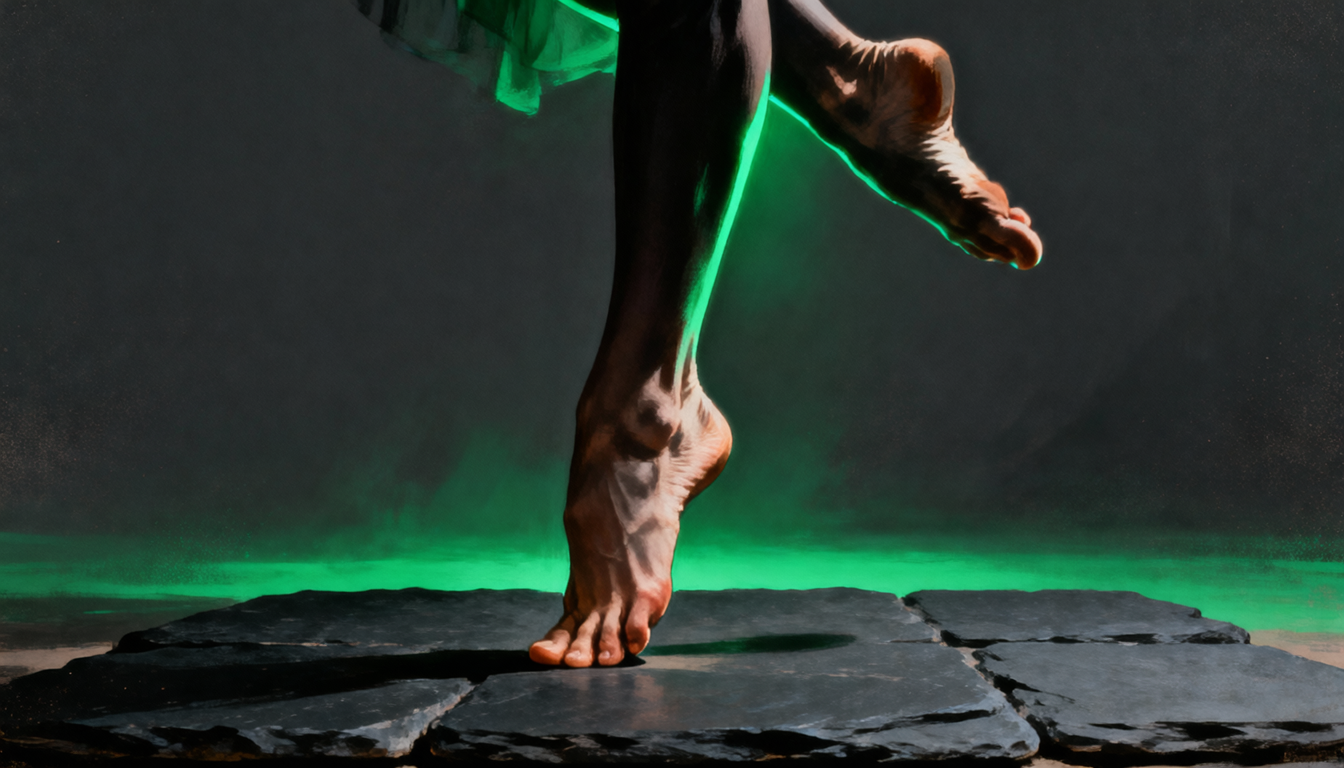
Walk into any gym and you’ll see men training what they can see — chest, arms, legs, back. Almost no one trains the thing that quietly decides whether they stay independent for their next thirty years.
Balance isn’t a party trick for old people. It’s a use-it-or-lose-it system that peaked in your twenties and has been declining ever since — silently, a few seconds a year — until one day you reach for your sock, lose your footing, and it’s suddenly a medical event instead of a stumble.
If you’ve already trained your grip strength, you’ve started on the upper-limb half of what we’ve been calling functional independence. Balance is the other half — the fall-risk and proprioception piece — and it’s just as neglected, and just as predictive.
The uncomfortable truth: by the time you notice your balance is gone, you’ve already spent a decade losing it. The good news is that it’s one of the most trainable systems in your body — if you start before you need to.
Why Balance Fades Without You Noticing
Balance is not a single muscle. It’s three inputs your brain fuses in real time: your inner ear (vestibular), your eyes (vision), and your proprioceptors — the sensors in your joints and feet that tell your brain where your body is in space without looking.
When all three agree, you stand without thinking about it. When one degrades, the others compensate — and here’s the trap: that compensation feels like “I’m fine.”
The decline is slow enough to be invisible. A healthy adult under 50 can typically hold a single-leg stance for the full 60-second test ceiling without difficulty. But the median collapses with each passing decade — and the drop is steeper than almost anyone expects.
The Test That Humbles Most Men Over 40
You can measure your own balance at home in ten seconds, no equipment:
- Stand barefoot on a flat, non-slip surface.
- Put your hands on your hips.
- Lift one foot to rest against the calf of the standing leg.
- Time yourself — stop when the raised foot touches down, your hands leave your hips, or your standing foot shifts.
The reference data (from the Canadian Longitudinal Study on Ageing, over 24,000 adults) is blunt. Men in their 50s and early 60s largely still hit the 60-second ceiling. But the median slips hard from there — and by 70+, many men can’t hold ten seconds.
If you’re in your 40s or 50s and can’t comfortably hold 30–60 seconds per leg, that’s not a “you’re getting old” shrug. It’s a leading indicator. The single-leg balance test is one of the simplest available proxies for fall risk — and falls are not a senior-only statistic. For a man who wants to train hard into his 70s, a fall is the event most likely to sideline him for good.
Balance Is Trainable — Far More Than People Assume
Here’s the part that should change how you train: balance was long assumed to be a hardwired reflex you couldn’t improve. It’s not.
A growing body of trials — led by a method called perturbation-based balance training — shows the opposite. Instead of just holding a static pose, you train the recovery: you practice losing your balance in a controlled way, and your nervous system gets measurably faster at catching itself. Repeated exposure to controlled slips and nudges teaches your body the exact instinct that breaks a real fall: a fast, automatic corrective step.
The results in meta-analyses are striking. Perturbation-based training cuts the rate of falls — and, more importantly, injurious falls — in older adults by a large margin, and the effect persists. One body of work found repeated-slip training cut annual fall risk by as much as 50%, especially in people with a history of falls.
Even without fancy equipment, the principle transfers. The goal of balance training isn’t to stand still — it’s to recover fast when stillness breaks.
How to Actually Train It
You don’t need a physio’s lab. You need to make balance a load-bearing habit, not a once-a-year check. Start here:
- Single-leg stance, daily. The test above is also the exercise. Work up to a steady 60 seconds each leg — then make it harder: close your eyes (this removes the visual crutch and forces your vestibular and proprioceptive systems to do the work).
- Progress to movement. Static holds are the floor. Add slow, controlled movements on one leg — a light single-leg Romanian deadlift, or stepping over an imaginary obstacle. This trains dynamic control, which is what matters in real life.
- Add perturbation when you’re ready. Have a partner give you a light, unexpected nudge while you stand on one leg or walk — just enough to force a corrective step. This is the home version of perturbation training, and it’s the highest-ROI drill in the whole practice.
- Train it before you need it. The entire point of the decade frame: you don’t train balance because you’re falling now. You train it so you never become someone who falls.
The Decade Frame
Here’s the shift that changes everything: balance is a skill you’ll use every single day for the rest of your life — tying shoes, getting out of a car, stepping off a curb, catching yourself on uneven ground. Strength you can see. Balance is invisible until the day it fails.
For the man who wants to be strong and independent at 70, 80, beyond — balance isn’t an accessory exercise. It’s the difference between a mild wobble and a broken hip, between “I still do my own yard work” and “I need someone to drive me.”
Train it now, on your terms, on your schedule. It’s one of the few investments where the payoff is measured not in how much you lift — but in how long you stay upright.
Sources
- Mayhew et al. (2023), Canadian Longitudinal Study on Ageing (CLSA), Age and Ageing. Normative single-leg balance values from ~25,000 community-dwelling adults aged 45–85 — the reference data behind the “30–60 second hold” benchmark and the steep decade-by-decade decline.
- Springer et al. (2007), Journal of Geriatric Physical Therapy. Normative values for the unipedal stance test by age and sex, eyes open and closed — documents the age-dependent decline in single-limb balance.
- Mansfield et al. (2015), Physical Therapy. Systematic review and meta-analysis of perturbation-based balance training in older adults — reduced falls vs. controls.
- Mohammadi, Lotfi & Zarei (2025), Journal of Applied Gerontology. Meta-analysis of perturbation-based balance training on fall incidence, mobility, postural control, and fear of falling in older adults.
- Gerards et al. (2017), Geriatrics & Gerontology International. Review of perturbation-based balance training for falls reduction — current evidence and clinical implementation.
- Pai et al. repeated-slip training studies — showed reductions in falls and balance loss after repeated-slip exposure, with retention up to 6 months and up to ~50% reduction in annual fall risk in fall-prone adults.